Manufacturing
Capabilities

Compression, transfer, and injection molding — all under one roof, all supported by our in-house Tool Room.

From Raw Compound to
Dispatched Part

01

Compound Preparation

Raw rubber is mixed with compound ingredients — carbon black, plasticizers, curing agents — in our internal mixing operation. Compound batches are controlled against approved formulation sheets before milling and calendering for press-ready preforms.

02

Molding

Preforms are loaded into compression, transfer, or injection molds and cured under controlled temperature and press pressure. Cure cycle time, temperature, and pressure are set per compound and part specification — not guesswork.

03

Deflashing & Finishing

Flash and parting-line excess material is removed through mechanical deflashing, shot blasting, or manual trimming depending on part geometry. Parts are cleaned and visually inspected before dimensional checks.

04

QC & Dispatch

Dimensional verification against customer drawing, hardness checks, visual inspection, and batch documentation. Every shipment is traceable back to compound batch, press, and cure cycle. No release without sign-off.

Four Processes.
Every Part.

From rubber moulding to sheet-metal and tube work — the capability to make the whole part, not just one piece of it.

Rubber Compression Molding

The workhorse of our shop floor. A measured rubber preform is placed into an open, heated mould; the press closes and applies controlled heat and pressure until the rubber flows to fill the cavity and vulcanises in place.

It is cost-effective across medium and high volumes, accepts a broad range of compounds and part sizes, and suits simple to moderately complex geometries. Our presses cover multiple tonnages and cavity counts, so the same process scales cleanly from sample runs to full production while holding dimensions to your drawing.

High VolumeCost EfficientBroad Compound Range

Rubber Injection Molding

Rubber compound is injected under high pressure into a fully closed mould — the fastest and most dimensionally repeatable rubber process we run. Shot size, cavity balance and cure cycle are managed by the machine controller and monitored on the floor.

Industries choose it for high-volume parts that demand tight tolerances, minimal flash and short cycle times. Because the closed-mould process wastes very little material, it also keeps compound cost under control on large runs — without giving up consistency from the first part to the last.

Tight TolerancesMinimal FlashRepeatable

Sheet Metal Stamping

Flat sheet metal is cut, formed and pressed into finished parts using dies in our presses. A single stroke can blank, pierce and form a part, which makes stamping fast and consistent once the tooling is proven.

It is how we produce the metal parts that pair with our rubber work — washers, brackets, clamps, retainers and bonding inserts — at volume and at a repeatable dimension. Dies are built and maintained in our own tool room, so lead times stay short and tolerances stay under our control.

Volume Metal PartsIn-House DiesRepeatable Tolerances

Machined & Turned Components

For turned and machined parts we cut, face, bore and thread components to drawing on lathes and milling machines — holding tight tolerances and clean finishes on every piece.

This capability lets us supply complete assemblies rather than just the rubber element — a machined housing with its seal already fitted, or a turned component with a bonded rubber mount. Industries rely on it to consolidate several bought-in parts into one supplier and one inspection record.

Complete AssembliesTight TolerancesMachined to Drawing

When Rubber Meets Steel

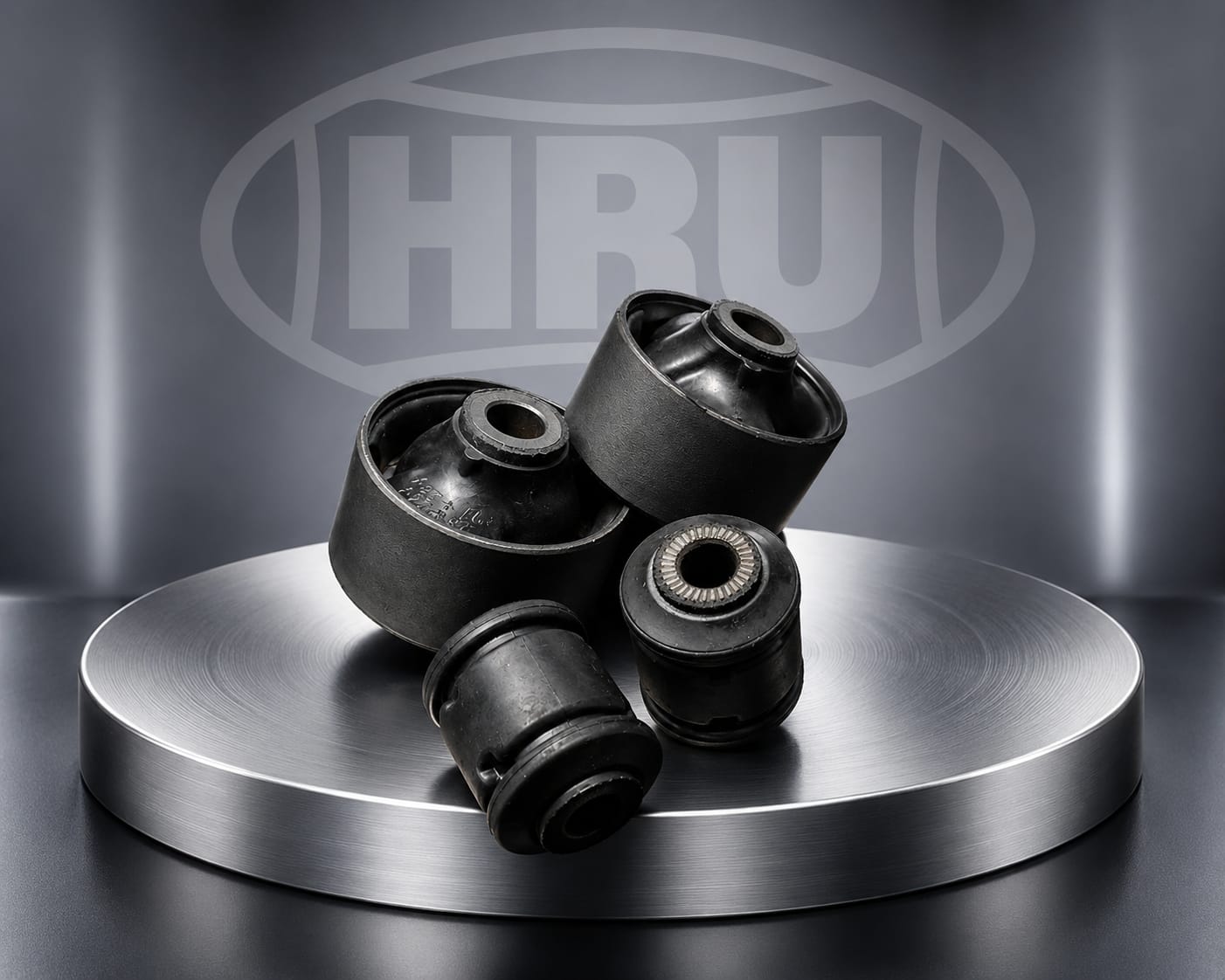
Rubber-to-metal bonded parts — suspension bushings, engine mounts, and vibration isolators — require more than a good mold. The metal insert must be correctly prepared (cleaned, shot-blasted, and adhesive-primed), the compound must be formulated for adhesion in addition to the service performance requirement, and the cure cycle must ensure complete vulcanization at the rubber-metal interface.

We carry out metal insert preparation, adhesive application, and bonded press molding in-house. Pull-out and bond strength testing is conducted on sample parts from each batch to verify interface integrity before release.
Insert Preparation & Priming
Controlled Cure Cycle
Pull-Out Strength Testing
Batch Traceability
Rubber-to-Metal Bonded Suspension Bushings by HRU

Featured: Suspension Bushings

Rubber-to-metal bonded suspension arm bushings, engine-chassis mounts, gearbox mounts, anti-roll bar links, steering column isolators, cab mounts for trucks and buses, and industrial machinery vibration isolation pads.

Metal Types

Mild steel, stainless steel, aluminium, and customer-supplied metal inserts.

Geometries

Cylindrical, conical, square, and custom bonded profile designs from customer drawings.

Every Batch. Every Dimension.
Every Shipment.

01

Incoming Material

Raw rubber compound is inspected on receipt — hardness verification, visual check, and certification review against approved compound specifications before release to production.

02

Mold Setup Approval

Before a production run begins, first-off samples are dimensionally checked against the customer drawing. Press parameters — temperature, pressure, cure time — are locked in the production record.

03

In-Process Checks

Dimensional spot-checks at defined intervals during the production run. Hardness checks on molded parts. Visual inspection for surface defects, flash, and incomplete fill.

04

Final Inspection

100% visual inspection plus dimensional sampling against the customer drawing before batch release. Non-conforming parts are segregated and the production log is updated.

05

Documentation

Each dispatched batch is traceable back to compound batch, press number, cure cycle, and QC sign-off. Delivery challans and inspection records are maintained for full lot traceability.

06

Dispatch

Packed per OEM or customer requirement — labeled with part number, batch reference, quantity, and date. Shipment is released only after QC sign-off is complete and recorded.

Share Your Drawing.
We'll Confirm Feasibility Within 24 Hours.

Send us your part drawing, compound specification, and volume requirement. We'll review and respond directly.